
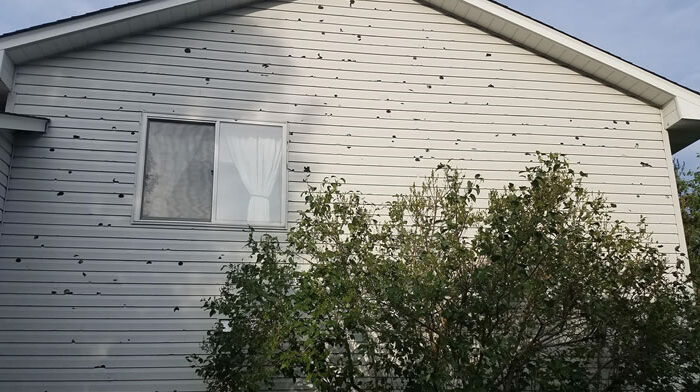
Hail Damage to Roof Systems: Assessing Functional Impact and Cause
The damage hail can inflict on buildings and property — particularly roof systems — has been a long-standing concern for both property owners and the insurance industry. Industry sources estimate that hail-related property damage in the United States approaches nearly one billion dollars annually, with losses appearing to increase over time. As a result, claims involving hail-strike damage are among the most common situations requiring forensic assessment.
Many hail-related claims arise from the perceived relationship between a recent hailstorm and deficiencies discovered in a building envelope. While hail can and does damage roofing materials, not all observed conditions are the result of hail impact. Accurate evaluation requires a clear understanding of what constitutes functional hail damage and the conditions under which it occurs.
A roof covering is considered functionally damaged by hail when its ability to shed water is reduced or when its expected service life is shortened as a direct result of impact. Cosmetic markings alone do not necessarily indicate functional damage. For functional impairment to occur, certain conditions must be present, and these conditions must be properly identified and analyzed through education, training, experience, and systematic site inspection methodology.
The most critical factor in determining functional hail damage is the size of the hailstone. Functional damage typically does not occur until hail reaches a threshold size specific to the type of roofing material. If hail lacks sufficient size, it does not possess the mass and kinetic energy necessary to damage the roofing system at the moment of impact. Threshold sizes vary depending on whether the roof covering consists of asphalt shingles, wood shakes, tile, or metal panels.
Hail size can vary significantly even within short distances during the same storm event. Because of this variability, hail size is best conservatively estimated through on-site evaluation. Damage to common, readily visible metal surfaces — such as roof vents, flashing, gutters, soft metals, and mechanical equipment — can provide valuable indicators of hailstone size and impact severity.
In addition to hail size, impact conditions play a key role in whether functional damage occurs. The perpendicularity of impact between the falling hailstone and the roof surface influences the transfer of energy. Factors such as roof slope, storm directionality, and wind-driven hail can alter impact angles and damage potential.
The condition of the roofing material at the time of impact is also an important consideration. Aging, weathering, prior mechanical damage, manufacturing defects, or improper installation can reduce a roof covering’s resistance to impact. Roofing materials with reduced impact resistance are more susceptible to damage at smaller hail sizes than new or properly installed systems.
Forensic hail assessments focus on evaluating all contributing factors rather than relying solely on storm occurrence. Proper analysis distinguishes between hail-related functional damage and conditions resulting from wear, installation issues, or other environmental exposures. This approach ensures accurate determination of cause, supports fair claim resolution, and reduces disputes related to hail damage attribution.